Digital Signature Certificate (DSC) Guide 2026: Benefits, Uses, Application Process, Cost & Everything You Need to Know
In today's rapidly evolving digital ecosystem, businesses, professionals, entrepreneurs, government contractors, and individuals are increasingly required to complete important transactions online. Whether it is filing income tax returns, registering a company, participating in government tenders, signing official documents, applying for licenses, or conducting secure online transactions, digital authentication has become essential.
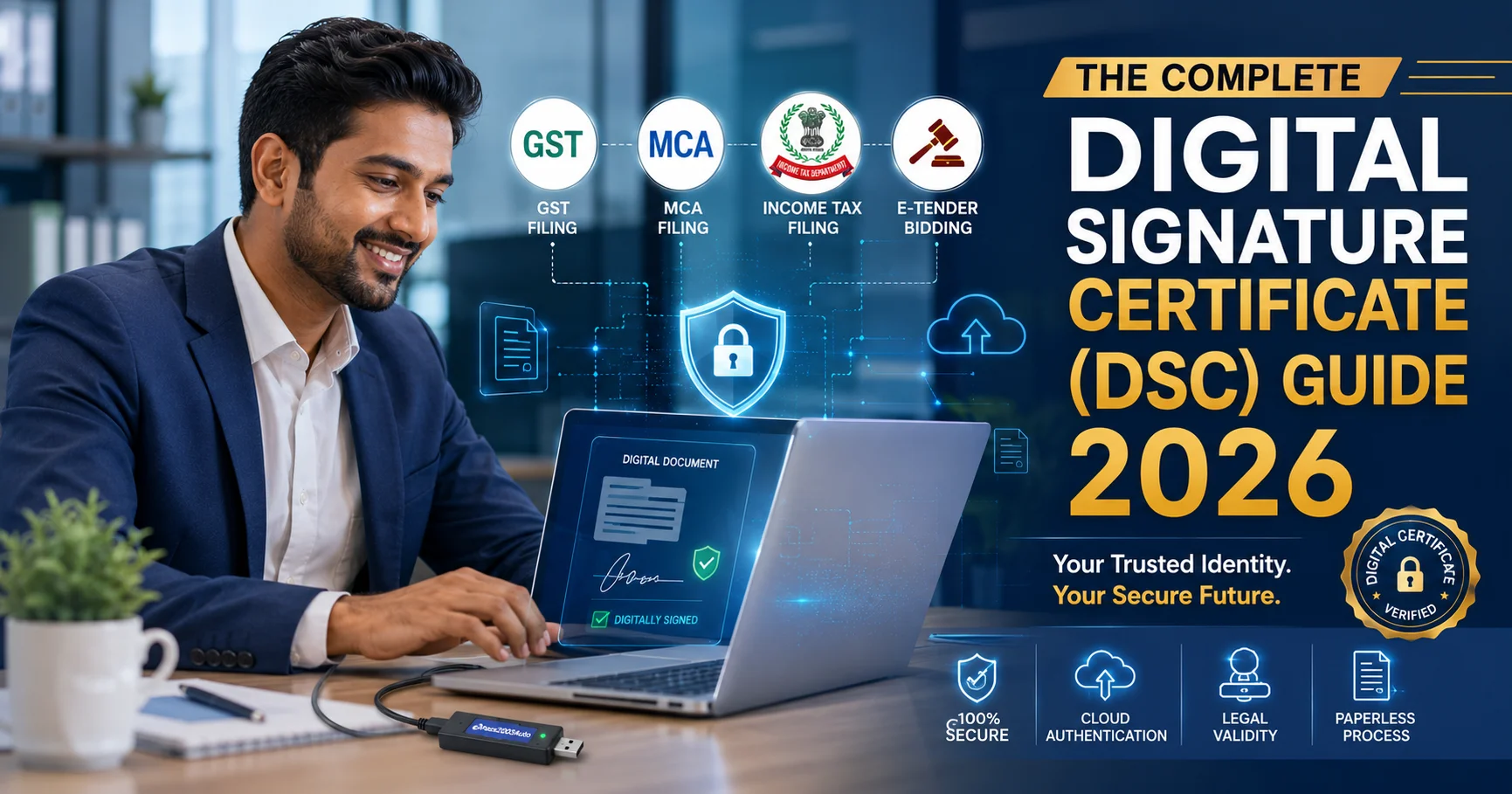
One of the most important tools enabling secure digital transactions is the Digital Signature Certificate (DSC). A DSC acts as a digital equivalent of a handwritten signature and provides authenticity, integrity, and security to electronic documents.
As businesses and government services continue to move online, obtaining a Digital Signature Certificate is no longer optional for many organizations and professionals. It has become a necessity for legal compliance, secure communication, and efficient document management.
This detailed guide explains everything about Digital Signature Certificates, including their meaning, types, benefits, applications, legal validity, costs, and the application process.
Papermitra.com provides Digital Signature Certificate application assistance at a nominal service charge of ₹499 + GST, helping individuals and businesses obtain their DSC quickly and conveniently.
What is a Digital Signature Certificate (DSC)?
A Digital Signature Certificate (DSC) is a secure electronic credential issued by a licensed Certifying Authority (CA) that verifies the identity of an individual, organization, or entity while signing digital documents.
Just as a handwritten signature validates a physical document, a DSC validates electronic documents and transactions. It uses advanced cryptographic technology to ensure that:
- The signer is genuine.
- The document has not been altered after signing.
- The signer cannot deny signing the document.
- The transaction remains secure and legally valid.
A Digital Signature Certificate contains important information such as:
- Name of certificate holder
- Email address
- Organization name (if applicable)
- Public key information
- Validity period
- Issuing Certifying Authority details
Why Digital Signatures Are Important in 2026
The digital transformation of businesses and government departments has significantly increased the need for secure online authentication. Organizations are increasingly replacing paper-based workflows with digital systems to save time, reduce costs, and improve operational efficiency.
Digital signatures provide:
- Legal authenticity
- Enhanced security
- Faster document approvals
- Reduced paperwork
- Improved compliance
- Environment-friendly operations
In many government and regulatory processes, DSC is now mandatory. Without a valid digital signature certificate, individuals and businesses may be unable to access certain online services.
How Does a Digital Signature Certificate Work?
A DSC works through Public Key Infrastructure (PKI), a cryptographic framework designed to secure digital communications and transactions.
The system consists of two keys:
- Private Key – Used by the signer to digitally sign documents.
- Public Key – Used by recipients to verify the authenticity of the signature.
When a document is digitally signed:
- A unique digital fingerprint called a hash is generated.
- The hash is encrypted using the private key.
- The encrypted hash is attached to the document.
- The recipient verifies the signature using the public key.
- If the document has been altered, verification fails.
This process ensures maximum security and prevents unauthorized modifications.
Legal Validity of Digital Signature Certificates in India
Digital signatures are legally recognized under the Information Technology Act, 2000. Documents signed using a valid DSC carry the same legal standing as physically signed documents in many official transactions.
The Government of India recognizes digital signatures for numerous services, including:
- Income Tax filings
- MCA filings
- GST filings
- E-Tender participation
- Government procurement
- Corporate compliance filings
This legal recognition makes DSC a trusted method for conducting secure digital business operations.
Types of Digital Signature Certificates
1. Class 3 Digital Signature Certificate
Class 3 DSC offers the highest level of security and identity verification. It is widely used for:
- E-Tendering
- E-Procurement
- Government contracts
- Online auctions
- High-value transactions
The applicant undergoes stringent verification before issuance.
2. Individual DSC
This certificate is issued to an individual and verifies personal identity.
Common uses include:
- Income Tax Return filing
- Personal document signing
- Government applications
- Professional certifications
3. Organization DSC
Issued to companies, LLPs, trusts, societies, and organizations, this DSC verifies organizational identity.
It is commonly used for:
- Corporate filings
- Company registrations
- Government contracts
- Regulatory compliance
4. DGFT DSC
Specially designed for exporters and importers dealing with the Directorate General of Foreign Trade (DGFT).
It helps businesses access various export-import services online.
Major Uses of Digital Signature Certificates
Digital Signature Certificates are used across multiple sectors and industries.
Income Tax Filing
Many taxpayers and businesses use DSC for secure filing of Income Tax Returns and related forms.
GST Compliance
Businesses use DSC to submit GST returns, applications, and amendments securely.
MCA Filings
Directors and companies require DSC for submitting forms to the Ministry of Corporate Affairs.
E-Tendering
Government departments and public sector organizations often mandate DSC for tender submissions.
E-Procurement
Digital signatures enable secure bidding and procurement processes.
EPFO Filings
Employers use DSC for employee-related filings and compliance activities.
Trademark and Patent Applications
Professionals use DSC while filing intellectual property applications online.
Contract Signing
Businesses increasingly use DSC to execute legally binding contracts electronically.
Benefits of Digital Signature Certificates
Enhanced Security
Digital signatures use advanced encryption technology that significantly reduces the risk of fraud and tampering.
Legal Acceptance
Documents signed using valid DSCs are legally recognized in many official transactions.
Time Saving
Users can sign documents from anywhere without printing, scanning, or couriering paperwork.
Cost Efficiency
Organizations save money on paper, printing, storage, and logistics.
Improved Productivity
Documents can be approved and processed much faster than traditional methods.
Environmental Benefits
Reducing paper consumption contributes to sustainability and environmental conservation.
Non-Repudiation
The signer cannot deny signing a digitally signed document.
Who Should Apply for a DSC?
A Digital Signature Certificate is useful for:
- Business owners
- Company directors
- Chartered accountants
- Company secretaries
- Tax consultants
- Government contractors
- Importers and exporters
- Freelancers
- Professionals
- Startups
- Partnership firms
- LLPs
- NGOs and societies
Documents Required for DSC Application
The required documents may vary slightly depending on the type of certificate and applicant category.
For Individuals
- PAN Card
- Aadhaar Card
- Mobile Number
- Email Address
- Passport-size Photograph
For Organizations
- Organization PAN
- GST Certificate (if applicable)
- Authorization Letter
- Identity Proof of Authorized Signatory
- Address Proof
DSC Application Process
The application process has become significantly easier with online verification systems.
- Select the required DSC type.
- Submit application details.
- Upload required documents.
- Complete identity verification.
- Perform video verification if required.
- Application review by Certifying Authority.
- Certificate issuance.
- Download and install DSC.
The entire process is often completed within a short period depending on verification requirements.
Validity of Digital Signature Certificates
Digital Signature Certificates are generally issued for specific validity periods.
| Validity Period | Suitable For | Benefits |
|---|---|---|
| 1 Year | Short-term users | Lower initial investment |
| 2 Years | Regular professionals | Better value |
| 3 Years | Businesses and enterprises | Long-term convenience |
Users should renew their DSC before expiry to avoid disruptions.
Common Mistakes to Avoid During DSC Application
- Providing incorrect PAN details
- Using mismatched names across documents
- Uploading unclear documents
- Providing inactive email addresses
- Using incorrect mobile numbers
- Ignoring renewal deadlines
A small error can delay approval and certificate issuance.
Digital Signature vs Electronic Signature
| Feature | Digital Signature | Electronic Signature |
|---|---|---|
| Security | Very High | Moderate |
| Encryption | Yes | Not Always |
| Identity Verification | Strong | Basic |
| Legal Reliability | Higher | Varies |
| Tamper Detection | Available | Limited |
Why Choose Papermitra.com for DSC Services?
Obtaining a Digital Signature Certificate can sometimes appear technical and confusing, especially for first-time applicants. Many users face difficulties understanding certificate types, document requirements, verification procedures, and installation processes.
At Papermitra.com, we simplify the entire DSC application journey.
Our service includes:
- Application assistance
- Document verification guidance
- Support throughout the approval process
- Quick response to customer queries
- Transparent pricing
- Professional support
We provide DSC application assistance at a nominal service charge of ₹499 + GST, making the process affordable and convenient for individuals, professionals, startups, and businesses.
Our objective is to help customers obtain their Digital Signature Certificate smoothly without unnecessary delays or confusion.
Future of Digital Signatures in India
India is rapidly moving toward a fully digital governance and business environment. Government initiatives, digital transformation programs, online compliance systems, and paperless workflows are driving increased adoption of Digital Signature Certificates.
In the coming years, DSC usage is expected to expand further across:
- Government services
- Corporate compliance
- Banking and finance
- Healthcare documentation
- Education systems
- Property transactions
- Cross-border business operations
As cybersecurity and authentication requirements become more stringent, Digital Signature Certificates will continue to play a critical role in secure online transactions.
Conclusion
A Digital Signature Certificate (DSC) has become an essential digital tool for individuals, professionals, businesses, and organizations that regularly interact with online government portals, compliance systems, tender platforms, and digital documentation processes. It provides strong security, legal validity, authentication, data integrity, and convenience while reducing paperwork and operational costs.
Whether you are filing taxes, managing company compliance, participating in government tenders, signing contracts, or conducting secure online transactions, a valid DSC helps ensure that your digital activities remain protected and legally recognized. With increasing digitization across India, the importance of Digital Signature Certificates will continue to grow.
If you need assistance obtaining a Digital Signature Certificate, Papermitra.com offers reliable support and application assistance at a nominal service charge of ₹499 + GST, helping you complete the process efficiently and confidently.